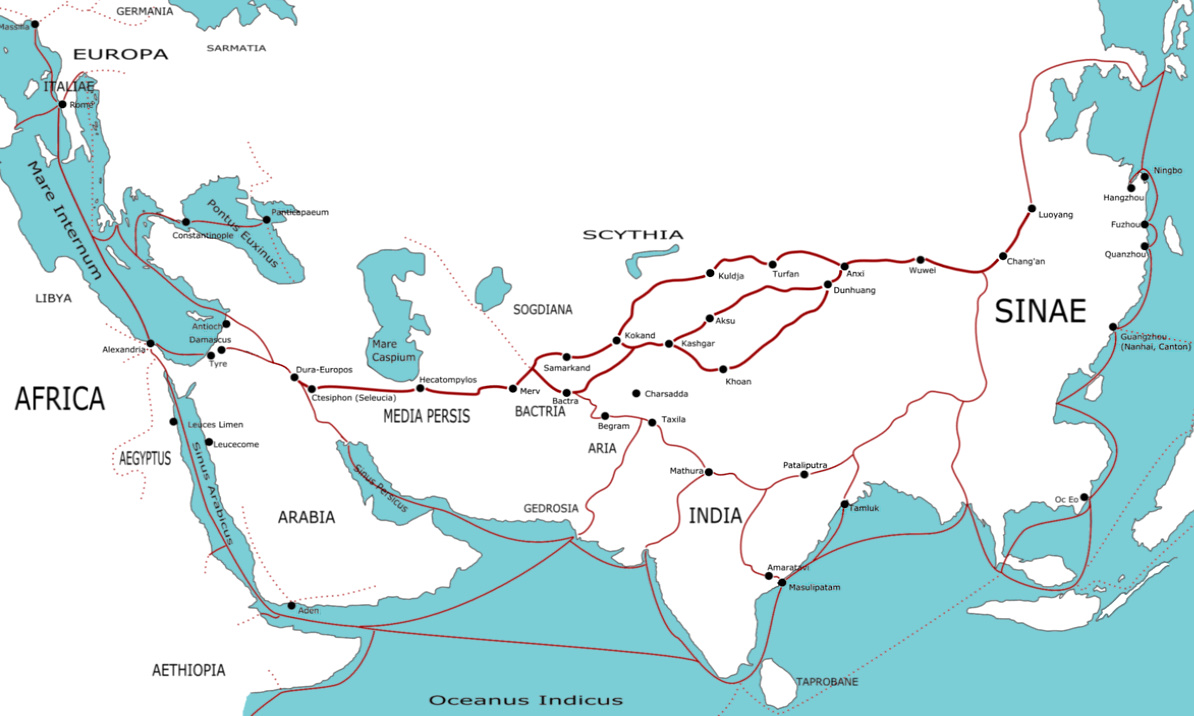
The silk road is a special term which describes the trade route between the central asia and china.
View Silk Road Map Routes Background. This map indicates trading routes used around the 1st century ce centred on the silk road. The silk road was and is a network of trade routes connecting the east and west, and was central to the economic, cultural, political, and religious interactions between these regions from the 2nd century. It is not easy to follow the silk road on the map, because there are several mail routes which also have many branches.
File:Silk route map.jpg - Wikipedia from upload.wikimedia.org
This trade route ran through gansu province via baoji, lanzhou, zhangye, jiuquan, jiayuguan and dunhuang along the hexi corridor. The map has several trading posts scattered evenly which are in fact plenty vaults. The ancient silk road conjures up many romantic images: Silk road is a significant symbol of the powerful civilization of east asia and central asia in the ancient time, which made great contribution to (the left map illustrates the three provinces in china covered by silk road). Here's what those changing paths look like as they create roads.
At the same time, via the the mapping and the presentation of the whole network of the early medieval silk roads helped to put the text in context and to understand the total.
Silk road travel distances map. All information is supplied without guarantee the maps are provided by google with the following information: „these directions are for planning purposes only. At the same time, via the the mapping and the presentation of the whole network of the early medieval silk roads helped to put the text in context and to understand the total. The overland route starts from xian, past gansu and xinjiang, traversing the sea route from the southeast coast of china, past south asia, and arrives at europe. The silk road consists of an extensive network of trade routes that has been around for over 2000 years, connecting the west with the east. Follow the story by clicking on the slides at the bottom of the map. This is very subjective and i plan in the new. Here's what those changing paths look like as they create roads. Maps from the 4th century b.c.